
Beyond the "Donroe Doctrine"
Or, my year of trying to make sense of U.S. foreign policy

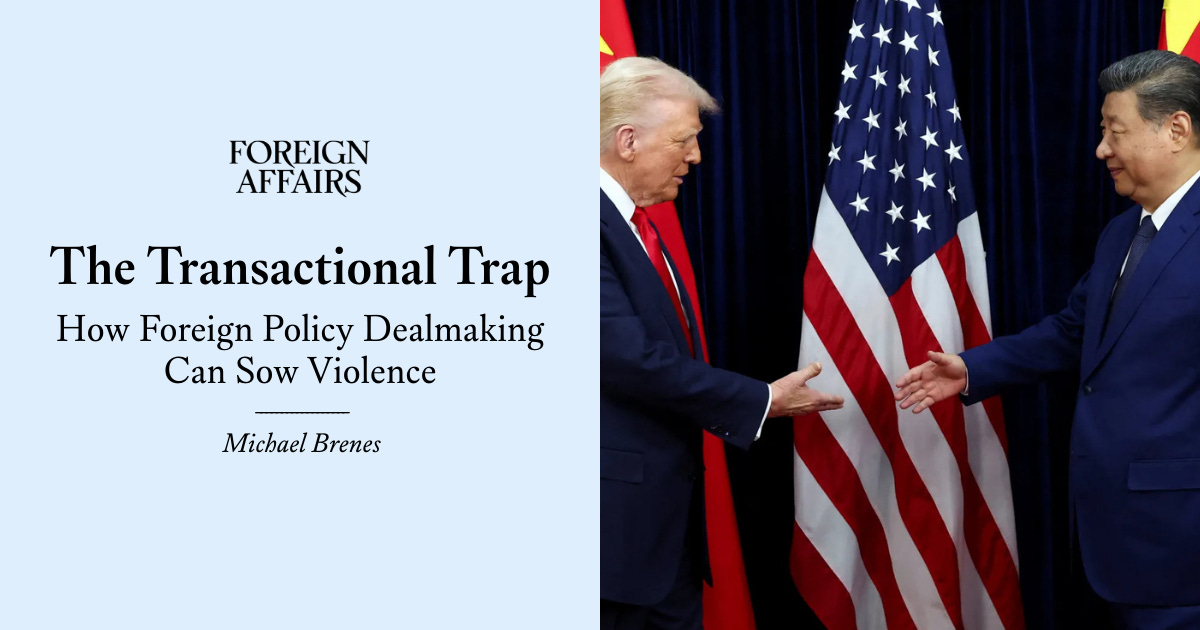
I have a new essay out in Foreign Affairs on the state and future of global order. You can read it here. The piece was inspired by my teaching in the Grand Strategy program at Yale and conversations with several colleagues and students in it. It also marks the culmination of a year-long effort, one joined at times by my friend and co-author Van Jackson, to make sense of Trump’s foreign policy and an increasingly multipolar world. This post is a chronology, a brief history, of my thinking over the past year on the state of U.S. foreign policy, specifically U.S.-China rivalry. This post is partly for me—a chronicle of my personal evolution. To the extent that it is useful to you, it offers a window into how one changes their mind, adjusts to new information, arrives at new conclusions and interests. It also marks an endpoint—and I’ll get to that later.
Like many who followed foreign policy under Trump 1.0, I started 2025 thinking that we would see a new, Trump 2.0 version of “great-power competition.” The publication of The Rivalry Peril (which you can order here at a steep discount) at the end of January allowed Van and I to expand upon our ideas that U.S.-China rivalry would remain constant, if malleable given Trump’s unpredictability. Van and I wrote a piece for Foreign Affairs (read it here) on the persistence of rivalry in an “age of nationalism,” and much of my commentary for promoting the book followed along these lines. I felt mired in speculation about U.S.-China relations during a podcast Van and I did for Lawfare, and a talk I gave at Brown University for a conference on “Demilitarizing U.S.-China Rivalry” hosted by Lyle Goldstein.
Trump talked the language of 19th century imperialists, but it seemed just that, talk. Annexing Greenland, invading Mexico; it was par for the course given Trump’s history and behavior. Smart commentators have long observed how Trump’s critique of “forever wars” belied his militarist tendencies, his acclaim for a one-trillion dollar defense budget (shout out to Bill Hartung and Ben Freeman’s new book); and on China, I thought Trump would be caught between his personalist affinity for Xi and his desire to constrain China through his version of mercantilism. Plus, the institutions of American national security—the Department of Defense (ahem, War) and the larger foreign policy bureaucracy—have been primed for an enduring U.S.-China rivalry for almost a decade. As the end of the Cold War showed us, those institutions cannot be halted or reversed overnight.
By the spring and into the summer, Trump’s policy toward China had yet to materialize. We did know that Trump was unpredictable—that he still seemed inclined toward making deals with China, but also punishing the Chinese (and global) economy with exorbitant tariffs. By the beginning of the summer, I personally had grown tired of the horserace, of chasing opinions and predictions about what Trump’s policy toward China might be. Trump is a mercurial figure and remains so; there is no “there there.” Better to start thinking about what comes next, I thought. I also believe that if the purpose of a progressive foreign policy is to envision a better world, then now was the ideal time to do so. Emma Ashford of the Stimson Center, and author of the great book First Among Equals, graciously invited me to contribute an essay to a project she was putting together with Nevada Lee on “New Visions for Grand Strategy.” I took the opportunity to write about a path for U.S. foreign policy after the “age of Trump,” one that eschewed competition and embraced a new multilateralism. You can read that essay and others from the project here. My essay echoed efforts by Mira Rapp Hooper and Rebecca Lissner to demand a “zero based” review of U.S. foreign policy, but differed in approach and style. I worried that competition with China will reemerge, or persist, depending upon your perspective, in a post-Trump era, undoing efforts to create a multilateral order that enfranchises the Global South and prioritizes welfare over warfare at home and abroad.
By the fall, Trump had revealed himself somewhat. The U.S. and China seemed to be shaping the world in a transactional manner, in a way that Van has characterized accurately as an “inter-imperial rivalry.” Trump’s meeting with Xi Jinping in late October yielded reduced tariffs and a deal on strategic minerals. The release of Trump’s National Security Strategy in December deprioritized China as a “pacing threat,” preferring to view China as an economic competitor with some vague language about deterring threats to Taiwan. I had also grown tired with critiquing Trump—it is often too easy. During the fall semester, many of the students in a Grand Strategy module class on the future of U.S. foreign policy were concerned about values: What does the United States stand for if not making the world safe for democracy? What kind of world do we want to exist in if human rights and humanitarian aid are not our business? What world do we want to make? What does global order look like in a new imperialist age, in a transactional world where the United States is pursuing a 19th century foreign policy in a multipolar world? I spent the semester working on my answers to these questions.
My recent essay for Foreign Affairs is the result. The state of the world is beyond Trump. I now worry that too much has been made of Trump as a transformative figure; that I have focused too much on U.S. foreign policy in the “age of Trump.” As Matt Duss recently noted, “the end of the ‘rules-based order’ required the work of multiple administrations…It’s not about one man, it’s about a system that has steadily lost legitimacy.” My piece opens with the line, “The post–World War II order is dead” and moves to diagnose why countries are pursuing transactional relationships with each other and why that could spell disaster for peace and global stability given what we know about global history. (If you are interested in my piece, pre-order Arne Westad’s new book, The Coming Storm.) I think of the essay as an effort to get beyond the conversation about the “Donroe Doctrine” and into the structure of the international system and why it is changing. Instead of making sense of Trump’s foreign policy, I now prefer to spend my time writing about the historical precedents that determine the present, preoccupied with diagnostic rather than prescriptive analysis.
This is to say that I am taking a break from writing about the future of U.S. foreign policy, for now. I’m focused on finishing my book on the War on Terror —it is moving along, and I am excited about where the book has taken me intellectually. It has also allowed me to be a historian again, and in the ways I know best.
I am not completely abandoning commentary. I have an essay coming out with Van on a “geopolitics of peace”—relying upon our collective ideas about the future for a progressive foreign policy—in a volume edited by Matt Duss, and I am working on a piece for a conference/future edited volume on why grand strategy should be studied as the history of grand failures. But those pieces are in the works, if almost finished; I don’t plan any new projects.
I will still be here, on Substack. I’ll be writing about the War on Terror, about the stuff that can’t make it into the book, about the writing process, and as always, the interrelationship between warfare and welfare. But I’d like to be just a historian. Although I reserve the right to go back on my word if any editors want to find me.